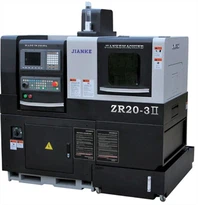
As a supplier of swiss type lathes, I often get asked about the accuracy of these remarkable machines. The accuracy of a swiss type lathe is a topic that holds great significance for manufacturers across various industries. In this blog post, I will delve into the factors that determine the accuracy of a swiss type lathe, explore the high - precision capabilities it offers, and discuss how different models in the market, such as the Hanwha Lathe and Tsugami Swiss Lathe, stack up in terms of accuracy.
Understanding the Basics of Swiss Type Lathe Accuracy
The accuracy of a swiss type lathe can be understood through several key factors. First and foremost is the spindle accuracy. The spindle is the core component that holds and rotates the workpiece. A high - quality spindle with minimal runout is essential for achieving accurate machining. Most modern swiss type lathes are engineered to have spindle runouts in the range of a few micrometers. For example, a well - designed spindle may have a radial runout of less than 5 micrometers, ensuring that the workpiece rotates precisely, which is crucial for turning operations.
Another vital factor is the linear motion system. Swiss type lathes use linear guides and ballscrews to control the movement of the tooling and the workpiece. High - precision linear guides with low friction and excellent stiffness contribute to accurate positioning of the tool. The ballscrews, which convert rotational motion into linear motion, need to be of high quality and properly maintained. Any backlash or wear in the ballscrews can affect the accuracy of the tool's movement, resulting in dimensional errors in the machined part.
The control system of the swiss type lathe also plays a significant role in determining accuracy. Advanced CNC (Computer Numerical Control) systems are capable of precise interpolation and motion control. They can execute complex machining programs with high repeatability. A high - end CNC system can control the movement of the axes to within a few tenths of a micrometer, providing consistent accuracy over a large number of machining cycles.
Measuring Accuracy in Swiss Type Lathes
The accuracy of a swiss type lathe is typically measured in terms of dimensional accuracy and geometric accuracy. Dimensional accuracy refers to how closely the actual dimensions of the machined part match the design specifications. For example, if a part is designed to have a diameter of 10 mm with a tolerance of ±0.01 mm, the swiss type lathe should be able to machine the part within this tolerance range.
Geometric accuracy, on the other hand, pertains to the shape and form of the machined part. This includes factors such as straightness, roundness, cylindricity, and flatness. A high - accuracy swiss type lathe can produce parts with excellent geometric characteristics. For instance, it can achieve roundness errors of less than 1 micrometer, ensuring that the turned parts are perfectly circular.
High - Precision Applications of Swiss Type Lathes
Swiss type lathes are widely used in industries where high precision is a must. One such industry is the medical device manufacturing. Medical implants, such as screws, pins, and stents, require extremely high accuracy to ensure proper fit and function within the human body. A swiss type lathe can machine these small, complex parts with the required precision, often achieving tolerances in the sub - micrometer range.
The aerospace industry is another major user of swiss type lathes. Components like turbine blades, fuel injectors, and fasteners need to be machined to very tight tolerances to ensure the safety and performance of aircraft. The high - speed machining capabilities of swiss type lathes, combined with their accuracy, make them ideal for producing these critical components.
The electronics industry also benefits from the accuracy of swiss type lathes. Miniature connectors, pins, and housings used in electronic devices need to be precisely machined to ensure proper electrical contact and functionality. Swiss type lathes can handle the small sizes and tight tolerances required in electronics manufacturing.
Comparing Accuracy of Different Swiss Type Lathe Models
There are many different models of swiss type lathes available in the market, each with its own accuracy characteristics. For example, the Hanwha Lathe is known for its high - precision machining capabilities. It is equipped with a state - of - the - art spindle and a high - performance CNC system, allowing it to achieve dimensional accuracies within a few micrometers. With its advanced linear guideways and ballscrew systems, it can also maintain excellent geometric accuracy during machining.
The Tsugami Swiss Lathe is another popular choice among manufacturers. Tsugami has a long - standing reputation for producing high - accuracy machines. Their lathes are designed with precision components and advanced control algorithms to ensure consistent accuracy over a large production volume. They are often used in high - end applications where the highest level of precision is required.
In addition to these specific models, many other manufacturers also offer high - accuracy swiss type lathes. When choosing a lathe, it is important to consider not only the machine's stated accuracy but also its overall build quality, the reputation of the manufacturer, and the level of technical support available.


Impact of Maintenance on Lathe Accuracy
Proper maintenance is crucial for maintaining the accuracy of a swiss type lathe. Regular cleaning and lubrication of the linear guides and ballscrews prevent wear and ensure smooth operation. The spindle should also be inspected regularly for any signs of damage or contamination. A damaged spindle can lead to increased runout, which directly affects the accuracy of the machined parts.
Calibration is another important aspect of maintenance. Periodic calibration of the CNC system and the measuring devices on the lathe ensures that the machine is operating within the specified accuracy limits. This involves checking and adjusting the linear and angular positions of the axes to ensure that they match the design specifications.
Enhancing Accuracy with Complementary Equipment
To further enhance the accuracy of swiss type lathes, complementary equipment can be used. For example, a High Speed CNC Horizontal Milling Machine Center can be used in conjunction with a swiss type lathe for multi - axis machining. The combination of the two machines allows for more complex machining operations and higher overall accuracy.
Advanced measuring equipment, such as coordinate measuring machines (CMMs), can be used to verify the accuracy of the machined parts. By measuring the parts after machining, any dimensional or geometric errors can be detected, and the lathe can be adjusted accordingly.
Conclusion and Call to Action
In conclusion, the accuracy of a swiss type lathe is determined by multiple factors, including the spindle, linear motion system, control system, and maintenance. These machines are capable of achieving extremely high levels of accuracy, making them indispensable in industries where precision is paramount.
Whether you are in the medical, aerospace, or electronics industry, a high - accuracy swiss type lathe can significantly improve the quality of your products. If you are looking for a reliable swiss type lathe that can meet your accuracy requirements, we are here to help. Our team of experts has in - depth knowledge of different lathe models and can assist you in choosing the right machine for your specific application.
If you are interested in learning more about our swiss type lathes or would like to discuss a potential purchase, we encourage you to reach out to us. We are eager to have a conversation with you about your machining needs and how our products can help you achieve the highest levels of accuracy in your manufacturing processes.
References
- "Precision Machining Handbook", McGraw - Hill
- "CNC Machining Technology", Wiley