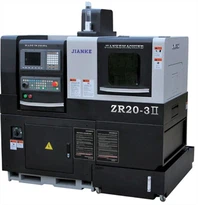
Hey there! As a supplier of 5-axis lathes, I've been getting a lot of questions lately about the role of the rotary axis in these super cool machines. So, I thought I'd sit down and write this blog to share what I know.
Let's start with the basics. A 5-axis lathe is a serious piece of kit. It can move along three linear axes (X, Y, and Z) and two rotary axes. These rotary axes are the game-changers here. They open up a whole new world of possibilities that just aren't possible with your standard 3-axis lathe.
One of the main roles of the rotary axis is to allow for complex geometries. In traditional machining, creating parts with intricate curves or angled features can be a real headache. You might have to move the part around multiple times, re-orient it, and hope everything lines up perfectly. With the rotary axis on a 5-axis lathe, that's all in the past.
For example, imagine you're making a turbocharger impeller. This part has all these twisted blades and complex curves. On a 3-axis machine, you'd be hard-pressed to get a smooth finish and accurate dimensions. But with a 5-axis lathe and its rotary axis, the machine can rotate the part as it cuts, following the contours of the blades precisely. It's like having a super-precise sculptor working on your part.


Another big advantage is the reduction in setup time. In a 3-axis lathe, if you need to machine different sides of a part, you have to stop the machine, move the part to a new position, and then make sure everything is lined up again. This can take a lot of time. The rotary axis on a 5-axis lathe allows you to machine multiple sides of a part in one setup. This not only saves time but also reduces the chances of errors that can come from repositioning the part.
Let's talk about surface finish. The rotary axis can also have a huge impact on the quality of the surface finish on your machined parts. When you can rotate the part during machining, the cutting tool can approach the material at the optimal angle. This means that the chips are removed more cleanly, and there's less chance of creating rough spots or burrs on the surface. The result is a part that looks better and often requires less post-machining finishing work.
In terms of productivity, the rotary axis is a real powerhouse. Since you can perform multiple operations in one setup, the overall machining time is significantly reduced. This means you can pump out more parts in less time, which is great news for your bottom line. It also allows you to take on more complex jobs that you might have had to turn down in the past.
Now, I know some of you might be thinking, "This all sounds great, but it must be really hard to program these 5-axis lathes with the rotary axis." And it's true, programming a 5-axis lathe is a bit more complex than a 3-axis one. But the good news is that there are a lot of advanced CAM (Computer-Aided Manufacturing) software packages out there that make it much easier. These software programs can generate the toolpaths for your 5-axis lathe, taking into account the movement of the rotary axis. With a bit of training, you and your team can become masters of 5-axis machining.
If you're in the market for a 5-axis lathe, I'd like to highlight some of the options we offer. We have a Multifunctional 5 Axis Machining Center that's a real workhorse. It comes with a powerful rotary axis that can handle all sorts of complex machining tasks. And for those of you who might need a more specialized machine, we also have a Single Spindle Automatic Lathe Machine that combines the benefits of automatic operation with the flexibility of a 5-axis setup.
And if you're looking for a great 3-axis option, we have the Nomura Swiss Lathe. While it doesn't have the full 5-axis capabilities, it's still a fantastic machine for many machining applications.
In conclusion, the rotary axis in a 5-axis lathe plays a crucial role in enabling complex machining, reducing setup time, improving surface finish, and increasing productivity. If you're in the manufacturing industry and want to take your machining capabilities to the next level, a 5-axis lathe with a reliable rotary axis is definitely worth considering.
If you're interested in learning more about our 5-axis lathes or want to discuss your specific machining needs, don't hesitate to reach out. We're here to help you find the perfect machine for your business.
References
- "CNC Machining Handbook" - A comprehensive guide to computer numerical control machining
- "Precision Machining Technology" - A book that covers various aspects of precision machining, including 5-axis machining
So, what are you waiting for? Contact us today to start a fruitful discussion about your 5-axis lathe requirements!